
By Vamika Poojari
When a friend says that a project is “still in its infancy,” the listener does not envision a baby in a crib. Instead, the listener effortlessly uses the characteristics of an infant’s vulnerability, dependence, and promise, to understand what their friend means.
It is human nature to seek and create connections, and the use of metaphor is, in many ways, It is our ability to conceptualize the world creatively ties linguistics, computer science, and the philosophy of mind together in a discipline that seeks to ask one question: is something understood, or is it simply imitated?
Artificial Neural Networks (LLMs) are increasingly becoming very common in our society. A closely connected question, then, arises:-
– Do large language models understand metaphors in the same way that humans do? Through an examination of the relevant research, this post will consider the aforementioned issue from Three different angles:
The linguistic nature -of the question suggests that LLMs would have difficulties understanding figurative language due to the unpredictability of the symbolic nature of language.
Computer science research– on the other hand, suggests that LLMs could reasonably understand metaphors in the same way that humans do.
An examination of cognitive science ultimately derailed the discussion, as the definition of understanding metaphors is highly dependent on what one means by ‘understanding.’
The Philosophical Divide– According to cognitive science, The human metaphor is rooted in physical senses that we experience daily (like warmth, weight, and distance). Lacking a body or consciousness, an LLM lacks the cognitive substrate required for genuine comprehension.
In short, an LLM’s ability to comprehend poetry is severely hampered by the fact that it does not have a physical form in the real world.
By studying these models from the inside, we can better understand what it means to comprehend something in a new branch of sciences and, perhaps more importantly, where that comprehension ends.
1. Methodological Framework: Structural Probing:-
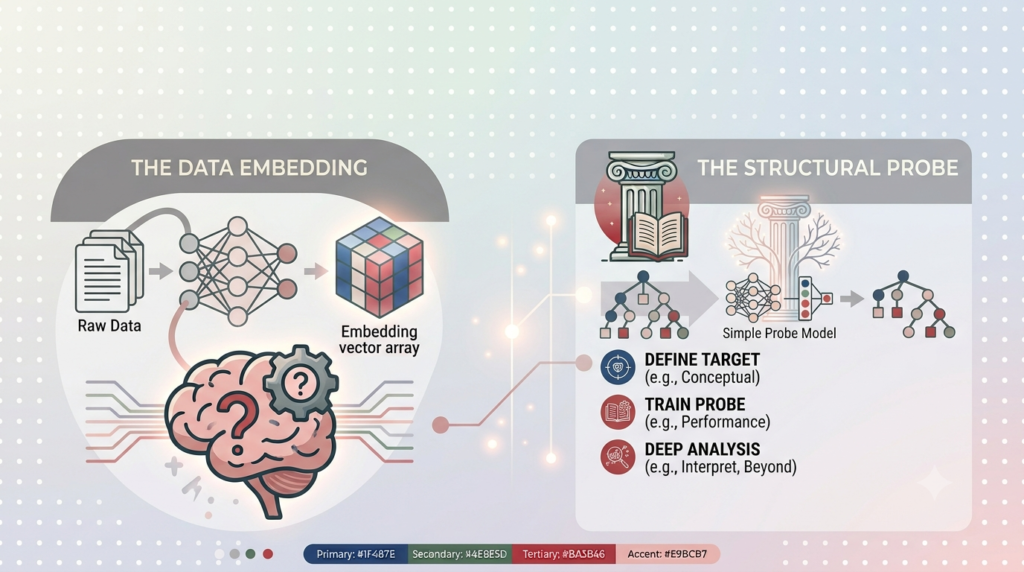
In order to find out whether language models internalise abstract syntax or simply depend on superficial surface patterns, we use diagnostic classifiers (probes).
For this purpose, we select the Universal Dependencies (UD) treebanks and BLiMP (Benchmark of Linguistic Minimal Pairs) in order to focus on particular syntactic phenomena (for example, subject-verb agreement and reflexives). We freeze the weights of the desired model (for instance, Llama-3-8B or Mistral-7B) and extract the hidden state vectors from different layers (the early, middle, and late ones).
We train a simple linear probe in order to predict syntactic features (such as tree depth or dependency relations). The reason for using a linear probe is that it shows the structural information is directly available in the representation itself and does not need to be calculated by a more complex probe.
2. Psycholinguistic Benchmarking:-
At this stage the LLM is regarded as a human subject and is given classic behavioral experiments in order to observe the bottlenecks in its processing.
When testing sentences such as “The horse raced past the barn fell.” we look at the model’s surprising values (i.e. the negative log-probabilities) to see whether or not the model undergoes re-analyses similar to those of a human when faced with structural ambiguity.
Long-distance dependencies: We assess the model’s capacity to observe the filler-gap constraints even when the distance between elements is great (for example, “What did the student say the professor forgot to bring to the…?”).
The evaluation metric involves tracking surprising alignment on a layer-by-layer basis in order to check whether linguistic anomalies are associated with spikes in computation or with certain structural vectors.
Surprisal Theory serves as a metric that helps us connect artificial structures with human behavior. In this approach we use Information Theory as it applies to psycholinguistics.
According to the frameworks created by John Hale and Roger Levy the effort that a human reader experiences is equal to the surprising of each word when it follows its prior context. This relationship is expressed in a formula that shows surprising as a function of context.

In Large Language Models we compute this value automatically by taking the log-likelihood of the next token.
When we plot the surprising vectors produced by the model alongside the reading times recorded from eye‑tracking studies, such as those in the Dundee Corpus or the Natural Stories Corpus, we can examine whether artificial neural networks face bottlenecks at the same structural points that human readers encounter.

Case Study A: The Garden-Path Re-analysis
Consider the psycholinguistic example: “The horse raced past the barn fell.
Human Processing: The human brain initially treats “raced” as the verb in an active construction. This creates a structural expectation. When the word “fell” appears the parser hits a wall. It can’t fit “fell” into the sentence structure without a major rethinking.
The brain must reanalyze the entire phrase. It realizes “raced past the barn” is not the action but a reduced relative clause modifying “the horse.” This re-analysis takes effort and time. It’s a garden-path effect. The sentence leads the reader down a misleading path.
LLM Processing: When we look at token-level in language models especially in early layers we often see patterns similar to human processing. The model may treat “raced” as a verb just like a person does. Then when “fell” appears, amazement spikes.
Indicating a processing difficulty.. In mid-to-late layers if the model has seen many similar constructions during training the ambiguity may resolve smoothly.
If amazement does not spike at “fell ” it suggests the model ,never fully committed to an interpretation. Instead it holds possible parses at once. A probabilistic superposition. This may mean the model avoids the kind of rigid structural commitment humans make.
Case Study B: Long-Distance Filler-Gap Dependencies
Human grammar often relies on filler-gap dependencies. These occur when a word (the filler) is moved from its position to the front of a sentence and must be linked to a gap later in the sentence
Take this example: “Which book did the student say the professor forgot to read..?”
Here “Which book” is the filler. It is moved to the beginning. The parser must keep it in working memory. It waits for the subcategorization frame. In this case the gap after “read”. Where the filler belongs. The distance between filler and gap can be long. The parser must maintain a link. This requires working memory and careful tracking.
Probing the attention matrices of models reveals how they handle this. Attention weights show which parts of the sentence the model is focusing on. In long-distance cases we can see attention patterns that suggest the model tracks the filler across the sentence..
The way it does so may differ from humans. Does the model keep the filler in memory like a person does?. Does it use statistical cues to predict the gap location? The attention patterns give clues.. They don’t always match human cognitive processes. These differences help us understand the limits and strengths of language models.
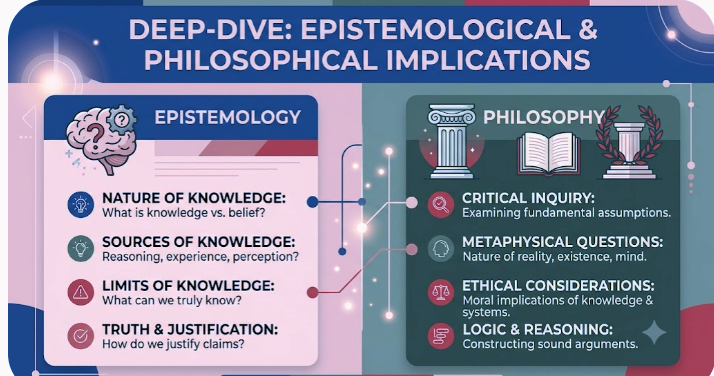
3. Deep-Dive: Epistemological & Philosophical Implications:-
The structural data and the psycholinguistic data collected from probing networks do not exist in a vacuum. The structural data and the psycholinguistic data directly affect one of the debates in science: Rationalism versus Empiricism.
Challenging the Poverty of the Stimulus
For decades generative linguistics, started by Noam Chomsky has upheld the Poverty of the Stimulus argument. The Poverty of the thesis says that the linguistic input a child receives while learning language is too sparse too noisy and too lacking in negative evidence to explain how the child builds a highly complex error‑free syntactic system. Therefore the Poverty of the thesis says that human language learning must be helped by an innate biologically predetermined Universal Grammar.
The unprecedented success of Large Language Models complicates this paradigm. Large Language Models, such as Llama‑3 or GPT‑4 have no blueprints, no pre‑defined parts of speech and no structural constraints. They see linear text sequences
. If structural probing shows that these Large Language Models abstract hierarchical syntax, resolve filler‑gap dependencies and respect island constraints through self‑supervised, next token prediction, the foundational pillar of the PoS argument is challenged.
It shows that hierarchical structure can naturally arise from statistical learning processes when combined with large amounts of data distribution.
4. Epistemological & Philosophical Implications:–
I think this computational alignment brings back the debate between Rationalism and Empiricism in the philosophy of mind.
Challenging the Poverty of the Stimulus: Generative grammar traditionally argues that a child’s linguistic input is too sparse to explain their rule‑bound fluency implying an Universal Grammar.
However ,LLMs have zero pre‑programmed rules. If a text‑only statistical network can construct a geometry that mirrors human fMRI data it proves that domain‑general statistical architectures are capable of discovering human‑like linguistic representations from data alone.
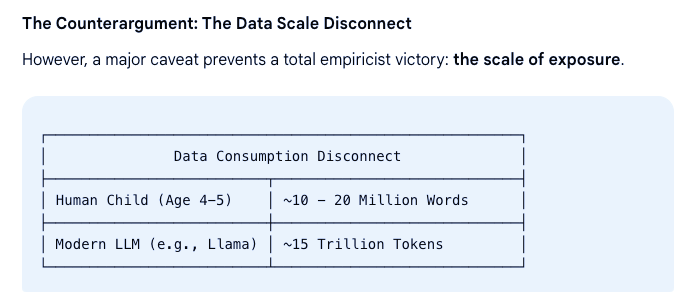
The Data Scale Disconnect: However a massive biological disconnect remains. A human child achieves fluency by age four on roughly ten to twenty million words of exposure. A top‑tier LLM requires fifteen plus trillion tokens to reach stability.
While LLMs prove syntax can emerge from statistics they do so through a massive data‑scaling trajectory that is entirely non‑biological.
5. Discussion:– Critical Limitations As this research framework advances we must remain critical of our diagnostic tools to avoid over‑interpreting alignment metrics.
The Probing Paradox: A major methodological barrier is determining whether a diagnostic classifier is extracting syntax that the LLM actively uses or if the probe itself is learning the syntax from vector regularities
. We must enforce linear constraints on our probes to ensure we are observing actual internal structure rather than an epiphenomenon of high‑dimensional vector spaces.
Moving Beyond “Stochastic Parrots”: Completely dismissing LLMs as statistical mirrors ignores the mathematically proven structural convergence shown in brain‑encoding models. The truth sits in a middle ground: LLMs are alien cognitive systems that simulate human linguistic structures using entirely non‑human, brute‑force statistical mechanisms.
6.Conclusions:-
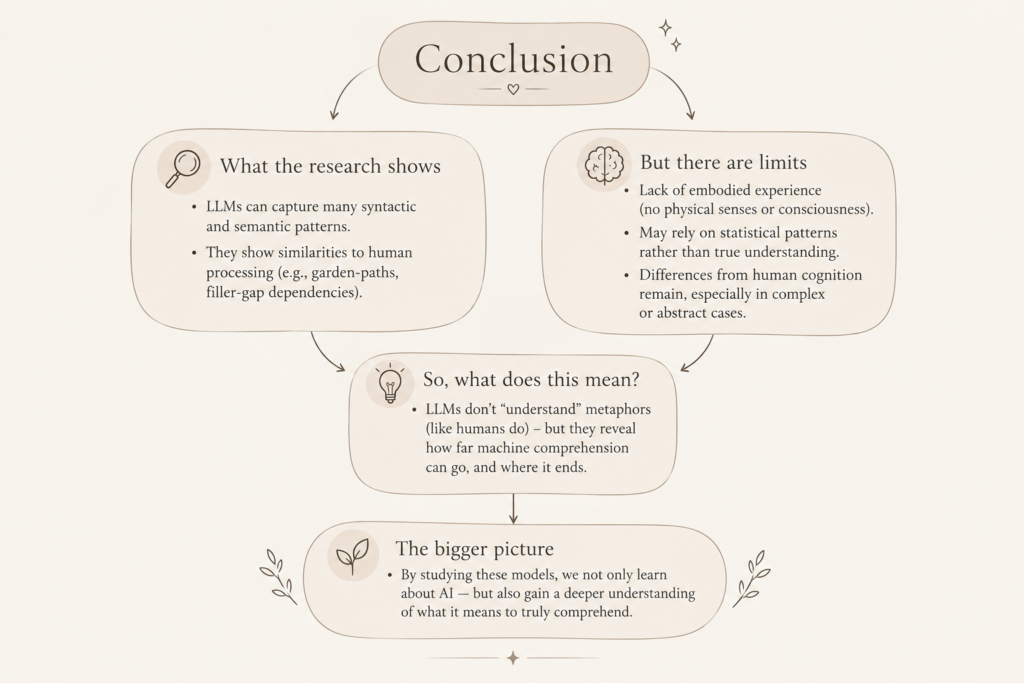
Probing neural networks and mapping them onto biological brains provides an unprecedented mirror into our own cognitive architecture. Modern NeuroAI is no longer a subfield of computer engineering; It is the ultimate empirical testing ground, for cognitive science.
By finding where the transformer’s silicon layers align with human gray matter and where they drastically diverge we bring linguistics, philosophy of mind and AI together to decode the fundamental nature of intelligence itself.
******